The front of a bag of cat food is marketing. The back is legislation – and that's where you'll find what's really inside. Once you know how a label is structured, you can tell in thirty seconds whether a food is suitable for your cat. This guide goes through the four blocks one by one.
📌 In brief
- First, look for the term «complete feed» (or «sole feed»). Only this can be given as a sole meal; «complementary» is a snack.
- The composition lists ingredients in descending order by weight: what comes first weighs the most.
- «With chicken» legally means at least 4% chicken. If you want more certainty, look for a specific percentage per ingredient.
- The analytical constituents (crude protein, crude fat, crude ash, crude fiber, moisture) allow you to compare two feeds fairly.
- Cats need taurine – check that it is listed under additives. Dog food often does not contain it.
Where is the most important information on the packaging?
Everything legally required is on the back or side, usually in small print. In the European Union, every pet food must at least state: the type of food (complete or complementary), the animal species, the composition, the analytical constituents, the additives, a feeding guideline, the net weight, the best-before date, and a batch number.
What does «complete» versus «complementary» feed mean?
A complete feed (sometimes called «sole feed») contains all the nutrients your cat needs and can therefore serve as the sole meal daily. A complementary feed is not: think of pâté snacks, lickable tubes, or meat mixes. If you give these as a main meal, you risk deficiencies in the long run.
How to read the composition (the ingredient list)?
Ingredients are listed in descending order by weight at the time of processing. If «grains» is listed first and «meat and animal by-products» third, you know enough. Also, pay attention to how specific the description is: «chicken (28%)» says much more than «meat and animal by-products».
There are two ways of listing. In an open declaration, each ingredient is named separately with a percentage. In a closed declaration, the manufacturer uses categories such as «grains» or «vegetable by-products», which means that the exact raw materials can vary per production batch. For cats with a food allergy, an open declaration is highly recommended.
💡 Tip: The claims on the front are legally regulated. «With chicken» means at least 4% chicken, «rich in chicken» typically at least 14%, and «chicken menu» or «chicken meal» at least 26%. If it only says «chicken flavor»? Then it could be less than 4%.
What do the analytical constituents say?
This is the block that allows you to objectively compare two feeds. Here's how to read it:
| Term on the label | What it means | Guideline for adult dry cat food |
|---|---|---|
| Crude protein | Total amount of protein, regardless of source | Approximately 30–40% |
| Crude fat (crude oils and fats) | Fat content, the main energy source | Approximately 10–20% |
| Crude ash (inorganic matter) | Minerals such as calcium and phosphorus — NOT filler | Preferably below 10% |
| Crude fiber (fibers) | Fibers; aid digestion and hairballs | Approximately 1–5% |
| Moisture | Water content; crucial for comparison | Dry food ±8%, wet food ±80% |
Be aware of the moisture content pitfall: wet food with «10% crude protein» seems meager next to dry food with 35%, but when converted to dry matter, that wet food comes out at about 50%. So never compare wet and dry directly. More on this in our article wet food or dry food for your cat.
Why is taurine so important on a cat food label?
Cats cannot produce enough taurine themselves. A deficiency can eventually lead to heart muscle and retinal problems. Therefore, taurine should be listed among the additives in a complete cat food, along with vitamin A, vitamin D3, and taurine sources. This is also why cat food and dog food are not interchangeable.
How to use the feeding guideline?
The table with grams per kilogram of body weight is a starting point, not a law. It assumes an average, neutered indoor cat with normal activity. Weigh your cat monthly and adjust based on condition rather than the table. Do you prefer to calculate concretely? See how much food your cat needs per day.
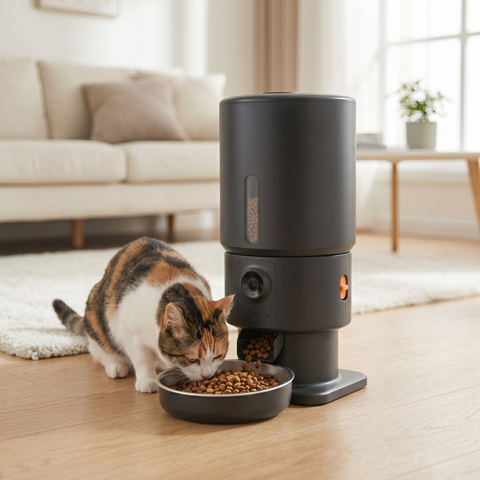
Precisely because portions are so critical, weighing is more important than estimating with a scoop. An automatic feeder does this identically every day.

ChromeFeeder — automatic feeder 2L (wifi)
Set the daily portion via the app and distribute it over multiple small meals. Exact portions, even when you're not home.
View product →What about the best-before date and storage?
The stated shelf life applies to an unopened bag. As soon as you open it, fats begin to oxidize: kibble becomes rancid, loses vitamins, and tastes less appealing. Expect four to six weeks after opening. Store the kibble in its original bag (which has a fat barrier), roll it tightly closed, and place it in an airtight container in a cool, dark place.

Desiccant Bags — moisture absorbers
Keep the kibble dry and crunchy in the storage bin, preserving vitamins and flavor longer.
View product →Also read why dry kibble gets soft and how to keep it crunchy and how to best store an opened bag of food.
⚠️ Pay attention to these signals
Always note the batch number and best-before date of the bag you are using – you will need them in case of a recall. Does the kibble smell rancid, or are there clumps or insects in it? Throw the bag away. Also see our guide on what to do in case of a cat food recall.
Frequently asked questions about cat food labels
Is «crude ash» bad for my cat?
No. Crude ash is simply the mineral fraction (calcium, phosphorus, magnesium) which your cat needs. Very high values can indicate a lot of bone material; for cats with bladder or kidney problems, it's best to discuss this with your vet.
What does «meat and animal by-products» mean?
This is a collective term for all animal parts not sold as meat for human consumption, such as liver, heart, lungs, or stomach. This is not inherently bad — organ meat is nutritious — but you don't know which animal species or part it is.
Does it have to be grain-free?
Not necessarily. Grains are not a problem for most cats; it's about overall quality and the proportion of animal protein. Grain-free is only relevant for a proven intolerance.
How do I recognize food for kittens or seniors?
The life stage is indicated on the label. Kitten food has more protein, fat, and calories; senior food often contains less phosphorus and more easily digestible protein. See also how much and how often a senior cat should eat.
Does price say something about quality?
Only partially. An expensive food with a closed declaration says less than a mid-range one with an open declaration and a high percentage of named meat. Read the label, not the price tag.
View SmartPaw's automatic feeders →
Written by the SmartPaw editorial team. Facts checked with veterinary and official sources: FEDIAF Nutritional Guidelines for Complete and Complementary Pet Food, European pet food labeling regulations (Regulation (EC) No. 767/2009), and the knowledge bases of AniCura and Royal Canin.
Published on August 25, 2026 · Last updated on August 25, 2026.
This blog is for informational purposes and does not replace veterinary advice.
Meer uit dit onderwerp

Hoe herken je een voedselallergie bij je kat?
Jeuk, braken of huidproblemen bij je kat? Ontdek de signalen van een voedselallergie, hoe je ze herkent en...

Hoeveel voedertijden kun je instellen op de ChromeFeeder?
Ontdek hoeveel voedertijden je instelt op de ChromeFeeder en hoe je vaste eetmomenten programmeert voor hond of kat.

Waarom loopt mijn automatische voerbak vast?
Automatische voerbak die vastloopt? Ontdek de 3 vaakste oorzaken en hoe je ze oplost. Lees de tips en...
Iets nodig voor je huisdier?
Onze fonteinen, voerbakken en de FurVac zijn gemaakt om je tijd te besparen en je huisdier gelukkiger te houden.
Naar de shop